
Funding Information
Home
What is the Pupil Premium Grant (PPG)?
The PPG is additional funding given to publicly funded schools in England to raise the attainment of pupils who are vulnerable to underachievement. The intention is that the grant will support schools in closing the gap between the academic performance of those children who are eligible to receive it and those who are not.
PPG funding is paid to schools according to the number of pupils that they have on roll who meet the following eligibility criteria:
– Pupils who are categorised as “Ever 6 FSM” – meaning those who are recorded in the school census as eligible for free school meals (FSM) now or in any of the previous six years.
– Pupils who are looked after, adopted from care or who have left care, including those on a Special Guardianship Order or Child Arrangements Order.
– Pupils who are categorised as “Ever 6 Service Children” – meaning pupils who are recorded as a service child now or have been in any of the previous six years. (These pupils will have at least one parent who is either serving in the regular armed forces or who is on full commitment as part of the full time reserve service.)
PPG income over time
Upon the grant’s introduction in 2014, schools received £953 extra in their budget per eligible primary-aged pupil. Over time, this figure has increased; the amount per eligible pupil during the 2025-2026 financial year will be £1,515.
Education Endowment Foundation (EEF) guidance on the use of PPG funding
The EEF advocate taking a tiered approach (see image below) to PPG spending as it helps balance the essential ingredients of an effective Pupil Premium plan: high quality teaching, targeted academic support, and supporting wider strategies.
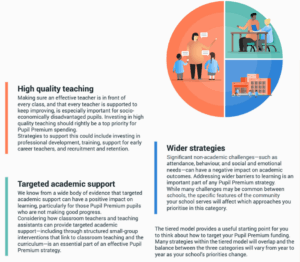
This approach aligns with the Department for Education’s template for creating a Pupil Premium strategy as well as its ‘menu of approaches’, which is a series of evidence-informed approaches that schools must select from when spending their PPG funding.
How do we spend PPG funding at Kingsteignton?
Our PPG spending is evidence-informed; for this reason, we place significant focus on ensuring that all children in the school receive quality-first teaching, something that the EEF recognise as being “a top priority for pupil premium spending.”
Our annual expenditure, which can be viewed in greater depth in our Pupil Premium Strategy document, can be categorised in the following five ways:
– Quality-first teaching – Staffing (the people working alongside the children)
– Quality-first teaching – Staff training / CPD (the training undertaken by the people working with the children)
– Quality-first teaching – Resources (the resources provided to support the children with their learning)
– Parental support / engagement (parents’ engagement with school and their child’s development as well as the school’s support for parents)
– Providing pupils with access to opportunities (the opportunities we enable pupils to access that they may not have been able to access without the support of the funding)
Myths regarding PPG spending
MYTH: “Only eligible children can benefit from Pupil Premium spending.”
The PPG is designed to support schools to raise the attainment of disadvantaged children. However, many of the most effective ways to do this – including improving the quality of teaching – will also benefit other groups: that is fine. Likewise, some forms of targeted academic support or wider strategies will benefit other children, including children with Special Educational Needs (SEND) and Children in Need (CiN).
MYTH: “Pupil Premium strategy can be separated from whole school strategy”
The PPG provides an important focus for prioritising the achievement of children from disadvantaged backgrounds in our education system. When it is most effective, the PPG will sit at the heart of a whole school effort, with all staff understanding the strategy and their role within it.
At Kingsteignton, the individual responsible for raising standards for children eligible for the PPG is Laura Armstrong, Assistant Headteacher. Laura ensures, through liaison with Lee Goodenough, Headteacher, that pupil premium strategy is embedded within whole school strategy.
Tracking progress
We track the pupils’ progress – both at an individual and cohort level – very carefully at precise and regular intervals (half termly Pupil Progress Meetings and termly ‘data drops’). Detailed data analysis is completed by Laura Armstrong and shared with the school’s governing board at scheduled intervals in the school year. The leadership team spend time ensuring that children eligible for the PPG are supported and stretched to the fullest extent. They are a priority group; senior leaders make sure all staff are acutely aware of both the needs and expectations surrounding individuals eligible for the PPG.
Furthermore, our support for, and the performance of, individuals eligible for the PPG is a key focus for Chantal Hamer & Jo Draper, governing board members responsible for monitoring our provision for disadvantaged pupils. Both Chantal and Jo conduct termly school visits, the outcomes of which are shared with our local governing board.
The school is working extremely hard to ensure the gap in attainment between those who are not eligible for pupil premium funding and those who are is closed and to ensure all children attain and achieve highly, irrespective of their background.
Further information
If you have any questions about our approach to pupil premium, feel free to contact Laura Armstrong (Assistant Headteacher) on info@kingsteigntonschool.org.uk.
If you believe your child may be eligible for the Pupil Premium Grant, please contact our school office as soon as possible as we can support you in exploring whether or not this is the case.
Pupil Premium
The PE and Sport premium is designed to help primary schools improve the quality of the PE and sport activities they offer their pupils. Details on how our school uses the money can be viewed below.